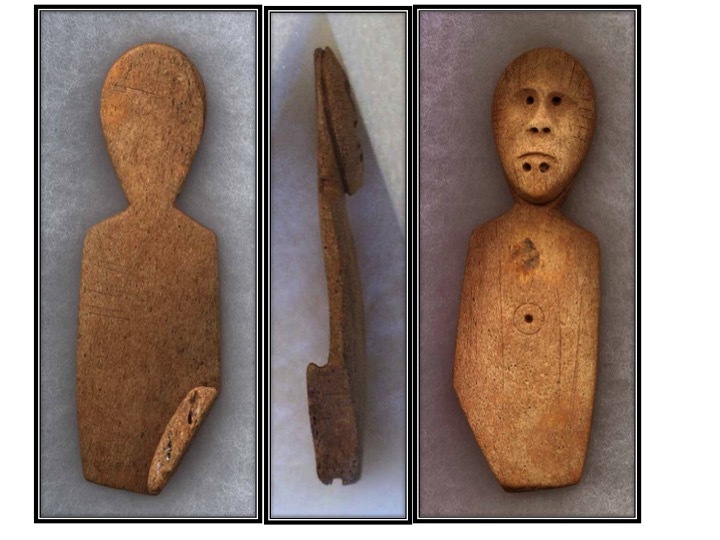
Udax̂tan
UNL-55
Udax̂tan is a large mound site located on the Amaknak spit (or Dutch Harbor spit) in
the City of Unalaska on Amaknak Island in the Fox Island group of the eastern Aleutians.
The site was formerly known as tanaxtaxak, derived from the Unangan word meaning field or garden. As reported
to Waldemar Jochelson by a local informant in 1909, the site was then known as
Tanaxtasak and probably derived from the fact that it was known as a place to collect
fertile soil for gardens through the 19th century. The site was a large village and, even
after being abandoned for 200 years, the location remained in the memory of Unalaska
Unangan into the early 19th century.
As a prominent site on Amaknak Island Udax̂tan, drew the attention of early
researchers in the Aleutians to the site. These include William Healy Dall (referring to
the site as Ulahkta Spit) who excavated the site briefly in the late 19th century and
Jochelson who tested the site in 1909 in connection with the Jessup Expedition. The site
was excavated in 2001 by the Museum of the Aleutians, directed by Rick Knecht.
Approximately 44 square meters were excavated in two separate excavation blocks.
Excavation revealed two cultural components at Tanaxtaxak. The upper, and more
extensive, component comprising the mound itself was occupied from 1300 – 1600 AD.
Analysis of the materials from Udax̂tan has contributed substantially to the
formulation of the Late Aleutian Tradition of the Eastern Aleutian Cultural sequence. The
lower cultural layer dates to c. 3,000 BP and consists of poorly preserved midden and a
scattering of lithic artifacts on top of the natural beach cobble surface.
The mound itself measures 150 meters in length by 30 meters in width and its maximum
elevation above the cobble surface of the spit is about 7 meters. The mound is composed
of stratified layers of cultural sediments, midden deposits, and bedded tephras. Midden is
formed by the accumulation of discarded animal bone, lithic artifacts, marine shell, and
other cultural debris generated during the occupation of the site. The upper layers of the
mound had been disturbed substantially by the construction of a gravel road and other
activities related to WWII. Beneath this, undisturbed cultural deposits extended to the
maximum depth of excavation and were mixed with beach cobbles and a tephra deposit at
the base of the main excavation block (Block A). No substantial occupational hiatuses
were identified in the main excavation block, suggesting that during the Later Aleutian
Phase the spit site was used consistently from about 1300 – 1600 AD, and possibly later.
The lowest cultural component of the site, exposed in Excavation Block B, could not be
linked to the main block’s stratigraphic profile, but does document the use of the location
shortly after the formation of the spit itself c. 3,000 BP. Further, the artifact assemblage is
composed of elements associated with the Margaret Bay phase and is consistent with
other Margaret Bay assemblages dated to 3,000 – 4,000 BP in Unalaska Bay.